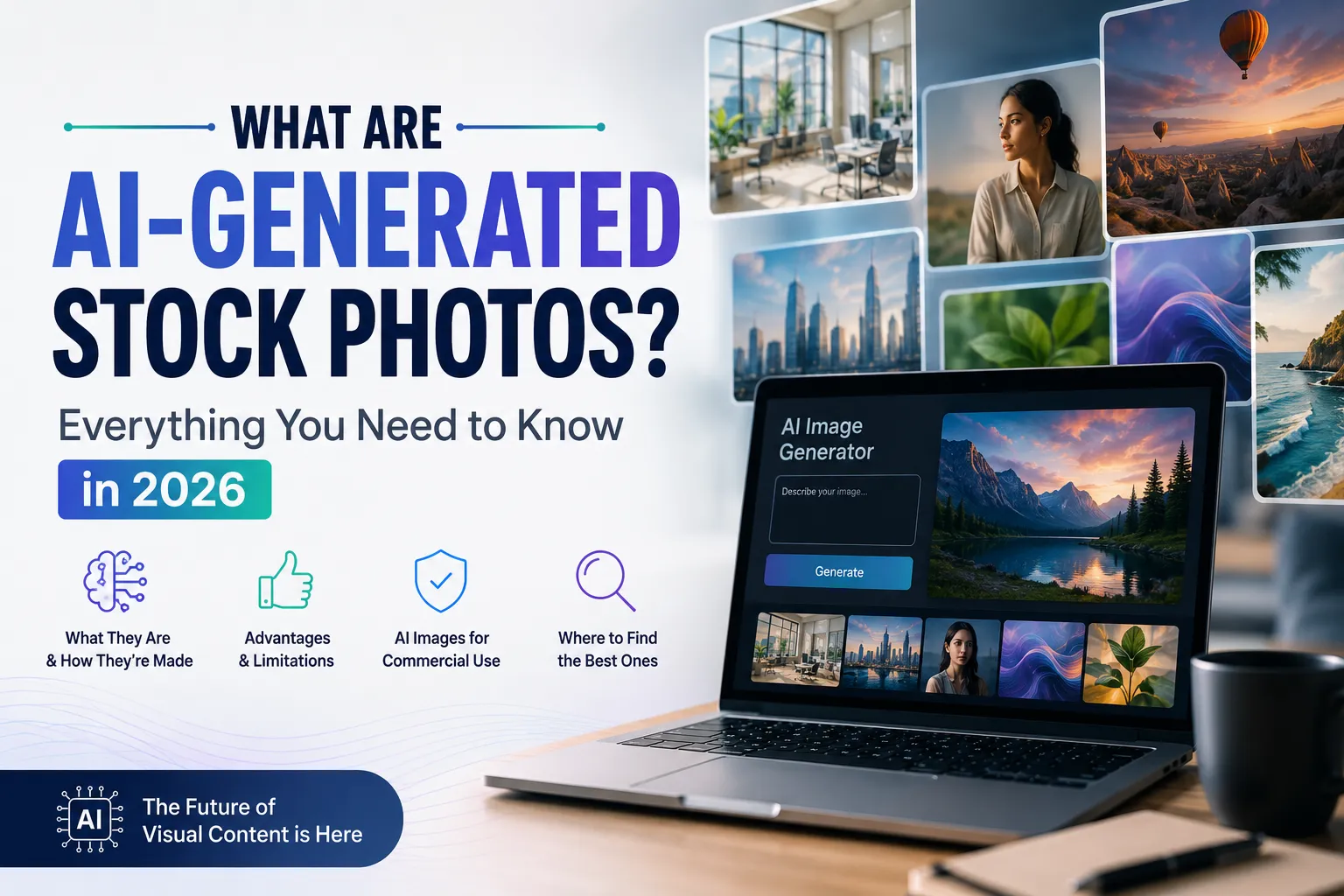
The stock photo industry has been quietly transformed by artificial intelligence. In 2026, AI-generated images are no longer a novelty — they're a mainstream tool used by marketers, designers, and businesses worldwide.
But what exactly are AI-generated stock photos? Are they legal to use commercially? And how do they compare to traditional photography?
This guide answers every question you might have.
What Are AI-Generated Stock Photos?
AI-generated images are visuals created entirely by artificial intelligence — no camera, no photographer, no physical location required. Using advanced machine learning models, AI can generate photorealistic images, illustrations, concept art, and branded visuals based on text descriptions.
For example, a prompt like "Indian female entrepreneur working on a laptop in a modern café, soft morning light" can produce a highly realistic image in seconds — an image that may never have been photographed before.
How Are They Made?
AI image generators use models trained on vast datasets of existing images and text. When given a written prompt, the AI interprets the description and synthesizes a new image from patterns it has learned.
Popular underlying technologies include diffusion models and generative adversarial networks (GANs). The output quality has improved dramatically — in many cases, AI images are indistinguishable from real photographs.
Why Are AI Stock Photos Useful?
1. Fills Content Gaps Some concepts are simply impossible or too expensive to photograph — futuristic cityscapes, abstract data visualizations, hyper-niche industry scenarios. AI can generate these on demand.
2. No Model Releases Required Traditional photography of real people requires model release forms for commercial use. AI-generated people have no such requirement, simplifying legal compliance.
3. Custom and On-Brand AI images can be generated to match specific color palettes, compositions, and aesthetics — something stock photography libraries can't easily offer.
4. Constantly Fresh Unlike traditional stock libraries that grow slowly, AI can produce new images instantly, meaning platforms like Arcanepix can add fresh, relevant content continuously.
5. Cost-Effective Generating an AI image costs a fraction of commissioning a professional photoshoot.
What Are the Limitations?
AI images are not perfect. Common issues include:
- Hands and fingers — AI still struggles with realistic hand anatomy
- Text in images — words generated by AI are often garbled or misspelled
- Inconsistency — generating the same person or setting twice with identical results is difficult
- Ethical debates — questions about AI training data and artist attribution are ongoing in the industry
For most commercial uses — website banners, social media posts, marketing materials — these limitations rarely matter. But for contexts requiring precise realism (medical imagery, legal documentation), traditional photography remains preferable.
Are AI Stock Photos Legal to Use Commercially?
This varies by platform. Always check the license terms of wherever you download from.
At Arcanepix, all images — including AI-generated ones — are provided free for commercial use, making them safe for websites, ads, presentations, and marketing campaigns.
Where Does AI Fit into the Future of Stock Photography?
AI and traditional photography are not competitors — they're complementary. The future of stock photo platforms lies in blending both: real photography for authenticity and human connection, AI generation for concepts, scale, and customization.
Arcanepix is already doing exactly this — combining professionally curated photography with AI-generated visuals to create a comprehensive, forward-looking image library.
Explore AI Images on Arcanepix
Visit arcanepix.com and explore categories like AI & Automation, Digital Marketing, Startup Culture, and Fintech & Online Payments — many of which feature AI-generated visuals ready for immediate commercial use.